

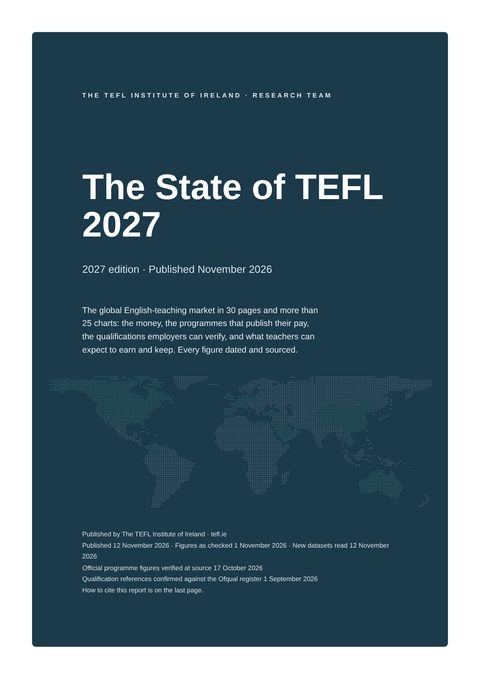
The State of TEFL 2027 is the global TEFL industry report from The TEFL Institute of Ireland (tefl.ie). It covers the English-teaching market, the four government programmes that publish their pay, the qualifications an employer can verify, and what Irish teachers can expect to earn and keep. Every figure is dated and sourced. Published 12 November 2026; figures as checked 1 November 2026.
It is a 30-page report with more than 25 charts. This page gives the main findings. If you are choosing a course, our accredited TEFL courses are regulated by Ofqual and awarded by Highfield Qualifications.
Download the full report (PDF, 30 pages, free, no email needed)
Jump to
How big is the TEFL market?
Market.us valued the global English language training market at US$89.5 billion in 2024 and forecasts US$181.1 billion by 2034, a compound annual growth rate of 7.3% from 2025 to 2034. Asia-Pacific held 42% of the 2024 market. About 1.5 billion people are learning English, on the British Council’s estimate. These market-size figures were checked against the publisher’s own page on 1 November 2026.
Other research houses give different numbers because they define the market differently. The Business Research Company projects US$122.7 billion by 2030, and Research and Markets puts digital English language learning at US$12.25 billion in 2025 rising to US$25.47 billion by 2030, about 15.8% a year. Those figures were compiled in March 2026 and have not been re-verified.
Which programmes publish their pay?
Four government programmes publish an official salary. Every other figure in circulation is a market estimate from job listings. The figures below were verified on each programme’s own page on 17 October 2026, and the application windows were as published on that date.
| Programme | Official pay | Application status, 17 October 2026 |
|---|---|---|
| Japan, JET | ¥4.02 million in year one (about US$2,120 a month); ¥4.14 million in year two | Closes 13 November 2026 for the US and Canada; 5 November 2026 for the UK |
| South Korea, EPIK | 2.2 to 2.8 million won a month on the main scale, with furnished apartment, severance and airfare | Rolling, no closing date; Spring 2027 intake |
| France, TAPIF | €1,010.67 a month gross, about €810 net, up to 12 hours a week | Open 15 October 2026 to 15 February 2027 |
| Spain, NALCAP | €800 to €1,000 a month, 14 to 16 hours a week | Closed; last call 2 to 30 June 2026, no next date published |
EPIK provides the apartment and JET does not, so a teacher who would otherwise pay city rent in Korea often keeps more of an EPIK salary. TAPIF and NALCAP are part-time assistant stipends, not living wages. Always check the programme’s own page before applying, as dates change.
Which TEFL qualification can an employer check?
A regulated one. Qualifications on the Ofqual Register of Regulated Qualifications carry a number any employer can search, with guided learning hours, total qualification time and awarding body. Our two diplomas are the Level 5 Diploma in TEFL (610/1571/4, 180 guided learning hours) and the Level 5 Advanced Diploma in TEFL (610/1573/8, 300 guided learning hours, 54 credits), both awarded by Highfield Qualifications. They are separate qualifications and are not combined. The register details were confirmed by hand on 1 September 2026.
RQF Level 5 is referenced to EQF Level 5, which is used by the 27 EU member states and other participating countries. A 120-hour certificate with no regulator behind it cannot be verified beyond the provider’s own word.
What do English teachers earn abroad?
Only the four official scales above are figures a teacher can hold an employer to. For everywhere else, market estimates compiled from job listings in March 2026 put the Gulf at US$2,200 to US$5,500 a month tax-free, East Asia at roughly US$1,200 to US$3,000, Southeast Asia at US$1,000 to US$2,000, Europe at €800 to €2,200 and Latin America at US$800 to US$1,100. These are estimates and have not been re-verified.
| Country | Monthly salary (estimate) | Monthly cost of living | Savings potential |
|---|---|---|---|
| Spain | €900 to €1,500 (NALCAP €800 to €1,000) | €800 to €1,200 | Low to moderate |
| Germany | €1,200 to €2,200 | €900 to €1,300 | Moderate |
| Italy | €1,000 to €1,600 | €900 to €1,300 | Low to moderate |
| Czech Republic | €900 to €1,400 | €600 to €900 | Moderate |
| Poland | €800 to €1,300 | €500 to €800 | Moderate |
Dublin’s average monthly rent is above €2,100 (March 2026 compilation, not an official statistic). A teacher on EPIK in Seoul pays no rent and a teacher in Dubai is usually housed and pays no income tax, so the net position after rent and tax matters more than the headline salary.
Where can an Irish teacher work without a visa?
An Irish citizen can live and work in all 27 EU member states, plus Iceland, Liechtenstein, Norway and Switzerland, without a work visa, and has Common Travel Area rights in the UK. Everywhere else the employer sponsors a work visa, and the visa, not the employer, sets the minimum qualifications. In most of East Asia and the Gulf that means a bachelor’s degree. Processing times in the report were compiled in March 2026 and are indicative, so confirm with the embassy before relying on them.
Is AI replacing English teachers?
Not on the evidence available. A 2025 study published in ScienceDirect found that combining ChatGPT with teacher feedback improved EFL learners’ argumentative writing, and that the teacher’s feedback made the difference. Teachers are using AI for planning, differentiation, feedback and pronunciation practice. Our free tools for teachers are at tefl.ai.
How the report was compiled
The Research Team at The TEFL Institute of Ireland read official programme pay on 17 October 2026, confirmed qualification references against the Ofqual register on 1 September 2026, and checked Market.us, Pew Research Center, Deloitte and Fortune figures against the publishers’ own pages on 1 November 2026. Figures carried forward from the March 2026 edition without re-verification are labelled as such. The report includes a corrections ledger listing what the March edition got wrong, including several figures withdrawn for lack of a source. No figure comes from the Institute’s own customer data.
How to cite: The TEFL Institute of Ireland, The State of TEFL 2027, 2027 edition, published November 2026, https://tefl.ie/wp-content/uploads/2026/11/state-of-tefl-2027-tefl-ie.pdf.
Disclosure: The TEFL Institute of Ireland sells TEFL courses, including the regulated qualifications above. No course is recommended in the report and no salary figure is drawn from our own data.