
Last reviewed: 20 August 2026
The best Transition Year ideas give students something they can point to at the end of the year. A module, project or placement works when it has a clear purpose, a visible outcome and an honest amount of time on the timetable. Everything else, however enjoyable on the day, tends to blur into the rest of the year.
Most Transition Year coordinators are not short of suggestions. They are short of a way to sort them. This guide is built around that problem: what the Transition Year Programme Statement actually asks for, how the main types of TY module compare, which ideas students remember, and which ones quietly fail every year in schools all over Ireland. It is written for coordinators and teachers first, and for parents who want to understand what a good TY year looks like.
Key takeaways
- A Transition Year idea earns its slot when it has a purpose, a visible outcome and a realistic time allocation. Two of the three is not enough.
- The redeveloped Transition Year Programme Statement took effect in September 2025 and organises the year around four student dimensions: Personal Growth, Being a Learner, Civic and Community Engagement, and Career Exploration.
- The Programme Statement suggests the equivalent of two to four weeks across work and community placements, and caps Maths, English and Irish at two hours per week each.
- An individual student portfolio, digital or physical, is a required element, supported by one class per week.
- The strongest TY ideas produce evidence: a certificate, a portfolio entry, a finished piece of work, a reference from a placement.
- Certification modules work well in TY because the outcome is external, dated and independent of the school’s own marking.
- Transition Year is optional and there is no state examination, so the year is judged on what students can show, not on a grade.
What makes a Transition Year idea actually work?
A Transition Year idea works when it has a stated purpose, a visible outcome and enough timetable space to finish properly. Those three tests do more filtering than any list of suggestions. An activity with a purpose but no outcome becomes a nice day out. An activity with an outcome but no time becomes a rushed half thing that nobody wants to show anyone.
The purpose test is the one coordinators skip most often, usually because a module has been running for years and nobody wants to be the person who asks why. It is worth asking anyway. If the answer is only “the students enjoy it”, that is a reason to keep something short, not a reason to give it a full term.
The outcome test is the most useful of the three, because it is the hardest to fudge. Ask what a student will be able to hold up in June. A certificate, a portfolio entry, a finished film, a working prototype, a completed placement with a named referee. If nothing comes to mind, the idea probably needs a smaller slot.
The time test is simply honesty about the calendar. A TY year has fewer usable weeks than it looks like on paper once you remove work experience, retreats, trips, mock interviews, exam supervision cover and the general drift of May. Coordinators who plan for roughly twenty five to twenty eight usable teaching weeks rarely get caught out. Coordinators who plan for thirty three usually do.
One more filter is worth applying before anything reaches the timetable: can it survive a teacher being out for a fortnight? Modules that depend entirely on one enthusiastic staff member are the ones that collapse mid year, and the students notice.
What does the Transition Year Programme Statement expect a programme to cover?
The Transition Year Programme Statement organises the year around four student dimensions and four curriculum dimensions, and schools design their own programme against that framework. The redeveloped statement took effect in September 2025, replacing the older guidelines, and it is the document to plan against rather than any list of popular modules.
The four student dimensions are the substance of the year. The four curriculum dimensions are how a school builds, runs and reviews it.
| Dimension | What the Programme Statement says | What it looks like on a timetable |
|---|---|---|
| Personal Growth | Students mature socially and emotionally, developing in areas including health and wellbeing, autonomy, identity, empathy and leadership | SPHE, PE, wellbeing modules, leadership roles, mentoring younger year groups |
| Being a Learner | Students begin to develop as senior cycle students, embracing strategies for learning that work best for them now and into the future | Research projects, study skills, subject sampling, independent learning tasks |
| Civic and Community Engagement | Students make a positive difference in their schools, communities and society | Community placements, fundraising with a purpose, local history and environment projects |
| Career Exploration | Students explore diverse future pathways in a guided and coordinated manner, gaining first hand workplace experience and career related competencies | Work experience, employer visits, mock interviews, certification modules |
Source: Transition Year Programme Statement, National Council for Curriculum and Assessment, in effect from September 2025. Wording of the dimensions quoted from the statement; timetable examples are our own.
The curriculum dimensions are Components, Teaching and Assessment, Recognising and Reporting, and Reflection and Renewal. The last one matters more than it sounds. It is the formal expectation that a school reviews and renews its programme rather than running the same modules indefinitely, which is exactly the audit most TY programmes need and rarely get.
How much timetable space do the required elements take?
The Programme Statement is specific about several time allocations, and those numbers are the single most useful planning input a coordinator has. Working out what is left after the required elements is a faster route to a workable timetable than starting with a wish list of modules.
| Element | Allocation | Status |
|---|---|---|
| Work and community based placement | Equivalent of two to four weeks of the programme | Suggested |
| Portfolio Development class | One class per week | Required support for the portfolio |
| Individual student portfolio, digital and or physical | Runs across the year | Required element |
| SPHE | Once per week, not exceeding one hour | Specified |
| Mathematics, English and Irish | Should not exceed two hours per week for each subject | Ceiling, not a target |
| Physical Education | Aligned to the Senior Cycle PE Framework | Specified |
Source: Transition Year Programme Statement, National Council for Curriculum and Assessment, in effect from September 2025. Figures are as stated in the programme statement.
The two hour ceiling on Maths, English and Irish is the line that surprises schools most. It is deliberately a ceiling. Where TY is timetabled as a lighter fifth year, those three subjects tend to expand to fill the space and the distinctive part of the year gets squeezed out.
Verified review
“Excellent Online Courses for Busy ESL Teachers…”
Sean R, July 2026. Rated 5 out of 5. Read the full review
What are the best Transition Year module ideas, compared?
Most Transition Year modules fall into five types, and they behave very differently on cost, staff workload and what the student ends up with. The table below is the comparison most coordinators are really making when they sit down in August.
| Module type | Typical examples | Staff workload | What the student has at the end | Main risk |
|---|---|---|---|---|
| Certification module | TEFL, first aid, coding, food safety, manual handling, lifeguarding | Low to moderate, depending on whether delivery is external | A dated certificate from an external body | Choosing a certificate with no recognised awarding body behind it |
| Subject sampling | Short tasters of Leaving Certificate subjects | Moderate, spread across many teachers | A better subject choice, rarely anything on paper | Too short to inform the choice it is meant to inform |
| Project and enterprise | Mini company, film, radio, local history, science fairs | High, concentrated on one or two staff | A finished piece of work and often a competition entry | Collapses if the lead teacher is out |
| Placement and community | Work experience, community placements, volunteering | High in admin, low in teaching | Experience plus a named referee | Placement quality varies enormously by student |
| Trips and one off events | Outdoor pursuits, retreats, cultural visits, guest speakers | Low per event, high on the calendar | The memory, and occasionally a skill | Quietly consuming the weeks other modules needed |
Source: our own categorisation, drawn from Transition Year programmes we work with in Irish schools. Workload and risk columns are typical rather than universal.
A balanced year usually contains something from at least four of those five rows. Programmes that lean too heavily on trips and one off events run out of weeks. Programmes built almost entirely from certification modules start to feel like a training course rather than a year of exploration.
Watch: what a TEFL qualification leads to later
The video below is a graduate story rather than a Transition Year one. It is included because coordinators are often asked by parents where a certification module actually goes. The answer is that it goes somewhere after school: teaching English abroad is work for adults, at eighteen or over, and nothing in Transition Year changes that. What a TY student gains now is the qualification and the skill, ready for later.
TEFL Stories
The TEFL Institute of Ireland
Teaching English in Spain as an Erasmus Student | Maia’s TEFL Experience
What Transition Year project ideas give students something to show?
Transition Year project ideas work best when the finished thing leaves the school. A project that is presented to an audience, entered into a competition, published, or handed to a real organisation carries a weight that an internal presentation does not, and students calibrate their effort accordingly.
Local history and oral history projects are consistently strong because the raw material is genuinely unavailable anywhere else. Students interviewing older residents, mapping a townland, or digitising a parish record produce something with real value, and the work sits naturally in the Civic and Community Engagement dimension.
Enterprise and mini company projects earn their reputation, with one caveat. The learning is in the failure points: pricing badly, ordering too much stock, missing a deadline. Coordinators who let those happen get far more out of the module than those who rescue every group.
Media projects, a short film, a podcast series, a school paper, work when the deadline is fixed and external. A screening night with parents in the room does more for standards than any rubric. Science and sustainability projects benefit from the same treatment, and the NCCA has developed micro-modules for schools including a ten hour micro-module for sustainable, student led actions.
The portfolio ties all of it together. Because an individual student portfolio is a required element with a weekly class behind it, every project should be planned with a portfolio entry in mind from the start rather than reconstructed in May.
Which Transition Year activities fall flat, and why?
Transition Year activities fail for a small number of repeatable reasons, and almost all of them are structural rather than a problem with the students. Naming them is more useful than another list of suggestions, because the same four patterns show up in school after school.
| What goes wrong | How it shows up | What well run programmes do instead |
|---|---|---|
| No outcome | A module runs all year and produces nothing a student can show or describe | Define the artefact before the module starts, even if it is small |
| Single point of failure | One teacher carries the module and it stalls when they are out | Pair every project module with a second staff member from the start |
| Calendar drift | Trips, retreats and events absorb the weeks a module needed | Timetable modules against a realistic count of usable weeks, not the full year |
| Unmarked, unrecognised effort | Students work hard on something that is never formally acknowledged | Use the Recognising and Reporting dimension deliberately: certificates, portfolio entries, an awards evening |
Source: our own observations from Transition Year programmes across Irish schools, mapped against the curriculum dimensions of the Transition Year Programme Statement.
The fourth pattern is worth dwelling on. Transition Year has no state examination, which is its great strength and its structural weakness at the same time. Nothing external forces recognition of the work, so recognition has to be designed in. Students who get nothing on paper for a year of genuine effort are the students who go home and tell their parents TY was a doss, and those parents are the ones who opt the next child out.
Where does a certification module like TEFL fit into a Transition Year programme?
A certification module fits into the Career Exploration dimension, and its particular value is that the outcome is external, dated and not dependent on the school’s own marking. That is unusual in a year with no examination, and it is why certification modules have become a fixture of Irish TY programmes.

The test to apply is the awarding body, not the brochure. Ask who regulates the qualification, whether the awarding body is named, and whether the certificate can be verified by a third party. A certificate issued by the provider that made the course, with nobody standing behind it, is a printout.
Our own Transition Year programme for Irish schools is one example of how this runs in practice. It is a 120 hour TEFL qualification, delivered online, Ofqual-regulated through Highfield with centre number 21335. Students can complete it in as little as three to four weeks or spread it across a term, with nine months of access, and it currently runs in forty eight schools across nineteen counties in Ireland and Northern Ireland. The schools and coordinators page sets out how it is administered.
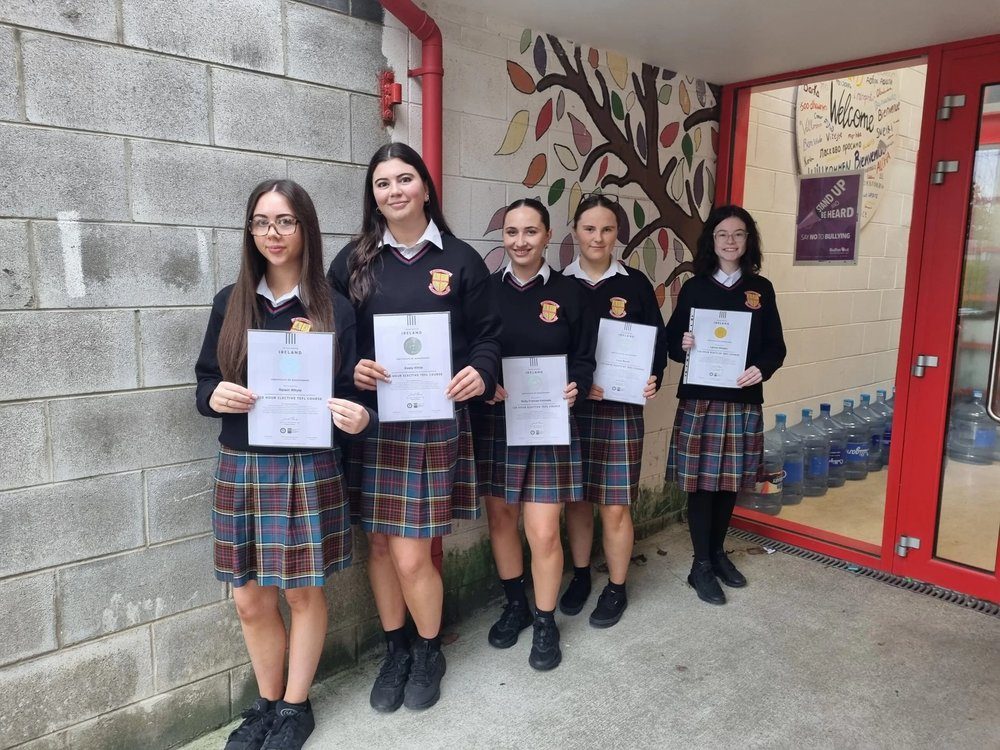
Ard Scoil na nDéise in Dungarvan, County Waterford is a useful example because the teacher was specific about what changed. TY teacher Siobhán Twomey said students are now “more aware of language learning and acquisition, and are more mindful of the challenges faced by our own visiting or EAL students in school”. The full Ard Scoil na nDéise Transition Year case study covers how the module was timetabled.
To be clear about what the qualification does and does not do at this age: a Transition Year student who completes a TEFL course holds a qualification and a genuinely useful skill set. They cannot work or teach abroad on the strength of it, and they should not be told otherwise. Teaching English abroad is adult work, at eighteen or over. What TY does is get the credential done early, which is why it appears so often in conversations about a structured gap year after the Leaving Certificate.
If you are weighing certification against other options, our guides to choosing a Transition Year course and to picking a TY elective go further into the comparison than there is room for here.
How do you plan a Transition Year programme that holds together?
Plan backwards from the four student dimensions and forwards from a realistic calendar, and let the modules fill the gap between the two. Coordinators who start with a module wish list end up rearranging it three times before Hallowe’en.
A working sequence that fits most schools:
- Count the usable weeks. Remove work experience, retreats, trips, exam weeks and the last fortnight of May before you count anything else.
- Place the required and specified elements first: portfolio class, SPHE, PE, and the capped hours for Maths, English and Irish.
- Fix the placement blocks in the calendar early, because employers and community partners book up.
- Map what is left against the four student dimensions and find the thin one. It is usually Civic and Community Engagement or Career Exploration.
- Choose modules to fill the thin dimension first, applying the purpose, outcome and time tests.
- Decide in advance how each module will be recognised in June, and put that date in the calendar now.
- Build in the review. The Reflection and Renewal dimension expects it, and it is the only thing that stops a programme calcifying.
For the official framework itself, the Transition Year Programme Statement on Curriculum Online is the primary document. Citizens Information has the plain language summary that is most useful to send to parents, and the Department of Education’s Senior Cycle Redevelopment pages confirm that Transition Year remains a standalone programme within senior cycle.
More in this Transition Year series
This guide is the hub for four companion pieces:
- Transition Year work experience ideas: what actually gets students placed
- The real disadvantages of Transition Year, and how schools fix them
- What is Transition Year in Ireland? A plain guide for students and parents
- TY online courses: what Irish students can actually take, and what counts
Frequently asked questions
Community and local history projects, oral history interviews, in school enterprise, peer mentoring and employer visits cost almost nothing and map cleanly onto the Civic and Community Engagement and Career Exploration dimensions. Online certification modules are usually the cheapest way to give every student an external, dated outcome.
There is no set number, because schools design their own programme against the Transition Year Programme Statement. In practice most coordinators find that fewer modules run properly beats more modules run partially. Count your usable teaching weeks first, place the required elements, then fill what genuinely remains.
No. Transition Year is an optional one year programme between Junior Cycle and Senior Cycle. All post primary schools have the option of offering it and most do, but admission criteria vary from school to school, and some schools run it as a compulsory year within their own structure.
There is no end of year state examination in Transition Year. Schools use ongoing school based assessment including portfolios, projects and practical activities, and students who complete the programme are usually awarded a certificate of participation by their school. An individual student portfolio is a required element of the programme.
Not while they are in Transition Year. Teaching English abroad is adult work and requires being eighteen or over, alongside the relevant visa and employer requirements. What a TY student gains now is a recognised qualification and a practical skill set, ready to use after school or during a gap year later on.
The Transition Year Programme Statement suggests a time allocation amounting to the equivalent of two to four weeks of the programme across work and community based placements. Schools split this in different ways, commonly two separate weeks in different sectors so students can compare two working environments.
Adding a certification module to your Transition Year programme
If a dated, externally awarded outcome is the gap in your programme, our TEFL module is built for exactly that slot. It is a 120 hour accredited TEFL course, delivered online and Ofqual-regulated through Highfield centre number 21335, run for schools with one member of staff holding the access code and nothing for teachers to prepare or mark. The TEFL Institute of Ireland was founded in 2017 and is Europe’s largest TEFL trainer by teachers certified, with more than 161,000 teachers certified in around 80 countries.
Coordinators can request tiered school pricing through the Transition Year schools page.
Already running the module in your school? If your students have completed the TEFL Transition Year programme, a short review from you would help other coordinators decide. Reviews from TY coordinators are the ones schools trust most, and they take about two minutes to leave.