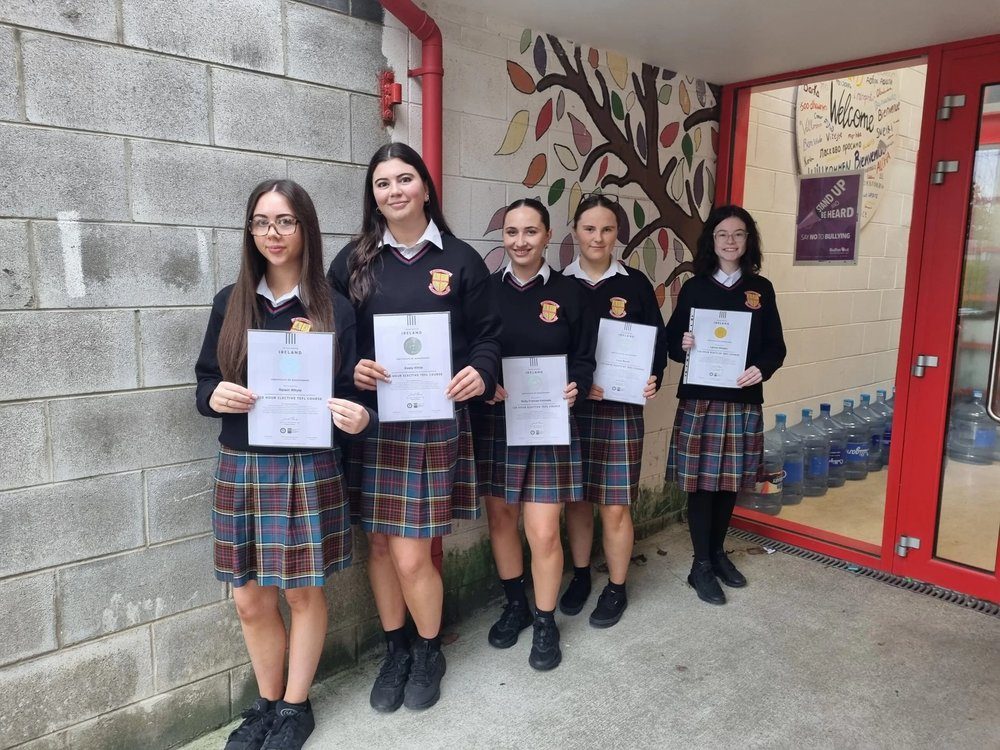

A Transition Year TEFL programme is a certified module in which TY students train to teach English as a foreign language, then finish with an accredited certificate they keep for life. Schools run it as an elective across a term or a full year, and it maps directly onto the TY Programme Statement’s four stated aims.
By Jessica Jeffery, School Partnership Manager, The TEFL Institute of Ireland
| Item | Figure or fact | Source |
|---|---|---|
| What Transition Year is | “A one-year optional programme available to all post-primary schools” | Curriculum Online, Transition Year |
| Governing document | TY Programme Statement, published August 2024 | NCCA and Curriculum Online |
| Course length | 120 hours, ten assessed modules | tefl.ie Transition Year page |
| Access period | Nine months per student | tefl.ie Transition Year page |
| Typical completion | Three to four weeks intensively, or one slot a week across a term | tefl.ie Transition Year page |
| Regulation and accreditation | Ofqual regulated, OTCAC accredited, 120 CPD credits with The CPD Group | tefl.ie Transition Year page |
| Schools running it | 48 schools across 19 counties | tefl.ie Transition Year page |
| Intake points | September and January starts | tefl.ie Transition Year page |
| Cost basis | Tiered by the number of students, quoted per school | tefl.ie Transition Year page |
| CAO points | None. CAO processes applications and the higher education institutions decide admissions | Central Applications Office |
Data verified 21 August 2026 against the official Transition Year page on Curriculum Online, the TY Programme Statement and our own Transition Year programme page. How to cite: The TEFL Institute of Ireland, “Transition Year TEFL at a glance”, verified 21 August 2026, tefl.ie.
What is a Transition Year TEFL programme?
A Transition Year TEFL programme is a structured teacher training course delivered to TY students inside the school year. Students learn how English is taught to speakers of other languages: how to plan a lesson, present new language clearly, manage a group, correct without crushing anyone, and adapt for different levels. At the end they sit assessment and receive a named, dated certificate in Teaching English as a Foreign Language.
The important word is qualification. Most Transition Year activity is valuable and temporary. A regulated TEFL certificate is valuable and permanent, which is why it behaves differently in a portfolio, in a college interview and in a first job application three or four years later.
There is a second reason schools reach for it. TEFL sits neatly across several TY aims at once. It develops communication, it demands independent work, it introduces a genuine professional skill, and it points at the wider world without anybody needing to leave the building. For a fuller treatment of the case for TEFL as an elective, see our guide to choosing the best Transition Year elective.
What does the official TY Programme Statement actually require?
The TY Programme Statement, published in August 2024, is the document a coordinator is actually working to. It sets out four things a school’s TY programme will do. It will “nurture the development of the student as a whole person by building on their previous experiences”. It will “create space and opportunities for meaningful, enjoyable learning experiences through which the key competencies of the student can be developed”. It will “expand the student’s experience and awareness of diverse future pathways and nurture the student’s capacity to sustain their growth”. And it will “evolve continuously to support the learning and development of the student through a reflection and renewal process”.
The statement describes programmes as “a combination of continued learning in some subjects, subject sampling, TY specific modules and other components”. A TEFL module is a TY specific module. That is the plain reading, and it is why TEFL does not need to be argued into the framework sideways.
One line in the statement matters more than any marketing claim. On reporting, it tells schools to account for “accredited and non-accredited micro-credentials from recognised bodies”. An Ofqual regulated TEFL certificate is an accredited micro-credential from a recognised body. If your school is looking for TY components that produce something documentable for the student’s portfolio rather than a photograph and a good memory, that sentence is the argument.
The NCCA’s Transition Year curriculum development pages carry the background to how the revised statement was built, including the consultation that closed in October 2023.

How does a school run a TEFL module in Transition Year?
The honest answer is that the school does far less than most coordinators expect, because the teaching and the marking sit with us rather than with your staff. Our Transition Year page puts it as “one member of staff holds the code, we do the rest”, and the practical consequence is that there is nothing to teach, nothing to prepare and nothing to mark.
Here is the sequence, start to finish.
- Enquire and get a quote. Pricing is tiered by the number of students, so the quote depends on your group size. Contact comes through the school partnership team rather than a shop checkout.
- Pick your slot in the timetable. Either three to four weeks of focused class time, or one slot a week across a term. Both routes reach the same 120 hours.
- Nominate one staff member to hold the access code. That person distributes access and can see progress. No subject expertise in English language teaching is required.
- Students work through the ten assessed modules. Nine months of access means a student who is out sick, on work experience or away for a trip does not lose the module.
- Collect the module records. Per student module records exist specifically so the school has evidence for TY review and reporting, and so the student has something concrete for a portfolio.
- Issue the certificates. Each student receives a named and dated certificate. That is the part they still have when they are 22.
For the longer version of this, written from the coordinator’s side of the desk, read our step by step guide to fitting an online TEFL course into your Transition Year programme. If you want to see it running in a real school, our write up of the TEFL Transition Year programme at Ard Scoil na nDéise in Dungarvan is the closest thing to a site visit.

What does it cost, and how much time does it take?
Cost is quoted per school rather than published per head, because it is tiered by the number of students. A group of twelve and a group of ninety are not the same commercial proposition, and pretending otherwise with a single headline price would mislead somebody. Ask for a quote with your actual expected numbers and you get a real figure.
Time is the more useful question for a coordinator, and it has a clean answer. The commitment is 120 hours of student learning, ten assessed modules, and a nine month access window that comfortably absorbs a term of interruptions. Staff time is close to zero beyond holding the code and checking in.
| Route | Shape | Suits a school that |
|---|---|---|
| Intensive block | Three to four weeks of focused class time | Runs TY in rotating blocks and wants a clean start and finish |
| Weekly slot | One timetabled slot a week across a term | Has a fixed TY timetable and prefers steady pacing |
| Either route | Nine months of access per student | Loses time to work experience, trips, exams or illness, which is every school |
Methodology: delivery options and access period as stated on the tefl.ie Transition Year page, checked 21 August 2026. Timetabling recommendations are our own practical guidance from schools already running the module.
Who recognises a Transition Year TEFL certificate?
Recognition is the question parents ask, and it deserves a precise answer rather than a reassuring one. There are three separate things people mean by it.
The first is regulation. The qualification route is Ofqual regulated, and tefl.ie describes itself as Ireland’s only Ofqual regulated TEFL provider. Regulation means a qualification record exists independently of us, which is what allows anybody to check rather than take our word for it.
The second is accreditation of the course itself. The programme is accredited by OTCAC, a UK based accreditor of online courses, and carries 120 CPD credits with The CPD Group. Our Transition Year page also lists us as a Gaisce President’s Award challenge partner, which matters to schools already running Gaisce.
The third is employer recognition, and here the honest position is that recognition is decided role by role. A language school in Ireland, a summer camp, an online tutoring platform and a school abroad each set their own bar, and some will want more hours or a degree. A 120 hour certificate earned at 16 is a real qualification and a genuine starting point. It is not a guarantee of a specific job, and any provider who tells a fifteen year old otherwise is selling rather than advising. If you want the detail on how recognition actually works, our guide to Transition Year courses in Ireland goes further into how schools and employers read the qualification.
Does a TEFL qualification help with CAO and college applications?
Not in points, and it is worth being blunt about that. The Central Applications Office processes applications for undergraduate courses, and as CAO itself states, “decisions on admissions to undergraduate courses are made by the HEIs who instruct CAO to make offers to successful candidates”. Points come from Leaving Certificate results. A TEFL certificate earned in Transition Year does not add to them.
Where it does work is everywhere else in the process. Portfolio and interview based routes, scholarship applications, access programmes and any course that asks a student to write about themselves all reward specifics over enthusiasm. “I completed a 120 hour Ofqual regulated teaching qualification in Transition Year and taught a practice lesson to my class” is a specific. It also happens to be true, dated and verifiable, which is more than most personal statements manage.
The same holds for a first part time job and for the year after school. Our guide to a gap year after the Leaving Cert covers what a student who already holds a TEFL certificate can do with it immediately.
When in the Transition Year calendar should a school run it?
Intakes are in September and January, and each has a distinct advantage.
A September start front loads the qualification. Students finish early, hold the certificate for the rest of the year, and can use it in work experience placements and in TY portfolio work. It also means the module is done before the spring, when TY calendars traditionally fill up with everything anyone forgot to schedule.
A January start suits schools that use the first term for settling, sampling and Gaisce, then want a substantial credential in the second half of the year. It also lands the certificate close to the point where students start thinking seriously about subject choice and life after school, which is when a professional qualification tends to land hardest.
Either way the nine month access window means a late start does not become a rush. If you are weighing TEFL against the other options on your TY menu, our comparison of the best online courses for Transition Year students and our overview of the best Transition Year courses in Ireland set the choice out side by side.
What do students actually come out with?
Three things, and it is worth separating them because they serve different purposes.
They come out with a named, dated certificate recognised internationally. They come out with ten assessed module records, which is the documentation a school needs for TY review and a student needs for a portfolio. And they come out with a set of skills that are unusually transferable for something learned at sixteen: explaining an idea to somebody who does not share your first language, standing in front of a group, planning something with a beginning and an end, and receiving correction without falling apart.
The last one is the part parents notice. A student who has planned and delivered a lesson has done something harder than most TY activities ask, and they know it. Our piece on why TEFL is one of the most useful Transition Year programmes for real world skills goes into the specific competencies in more detail.
The honest limitations
Three, stated plainly, because a guide that only lists advantages is an advertisement.
It is online and self paced. That suits most students and frustrates a few. A student who needs a teacher in the room to keep momentum will need somebody checking in, which is a small ask but not a zero ask.
It is a 120 hour certificate, not a degree or a Level 5 diploma. It opens a door. It does not walk through it. Students who want to teach seriously will add hours and qualifications later.
And it produces a qualification a fifteen year old may not use for years. That is fine, and it is arguably the point, but it means the value shows up late. If your school is measuring TY components on immediate visible engagement alone, a certificate that pays off at 20 will look quieter in November than a trip to a farm.
Every Transition Year TEFL guide on tefl.ie
This page is the hub. Everything below goes deeper on one part of it.
- The Transition Year programme for schools. The programme itself, pricing basis, and how to request a quote or brochure.
- Fitting an online TEFL course into your Transition Year programme. The coordinator’s step by step guide.
- Choosing the best Transition Year elective. How TEFL compares with the other electives on a TY menu.
- The best Transition Year courses in Ireland. The wider field, and where TEFL sits in it.
- Transition Year courses in Ireland. What schools look for, and which subjects combine well with a TEFL module.
- Courses for Transition Year students in Dublin, Cork, Limerick and Galway. The programme mechanics, seen city by city.
- The best online courses for Transition Year students. Six TY course categories compared.
- Transition Year programmes for real world skills. The competencies TEFL actually builds.
- The TEFL Transition Year programme at Ard Scoil na nDéise, Dungarvan. One school’s experience of running it.
- A gap year after the Leaving Cert. What a student does with the certificate after school.
Bring a TEFL module into your school’s Transition Year programme
If you coordinate Transition Year and you want a component that produces a documented, regulated qualification rather than a memory, the next step is a quote with your real student numbers. Pricing is tiered by group size, intakes are September and January, and the school side of the work is one member of staff holding an access code.
Start on our Transition Year programme page, where you can request the school brochure or a quote directly. If you would rather ask a question first, our school partnership team answers TY enquiries at schoolelective@tefl.ie.
{“@context”:”https://schema.org”,”@graph”:[{“@type”:”Article”,”@id”:”https://tefl.ie/transition-year-tefl-programmes-guide/#article”,”mainEntityOfPage”:{“@type”:”WebPage”,”@id”:”https://tefl.ie/transition-year-tefl-programmes-guide/”},”headline”:”Transition Year TEFL Programmes: The Complete Guide for Schools, Students and Parents”,”description”:”A Transition Year TEFL programme is a certified module in which TY students train to teach English as a foreign language and finish with an accredited certificate. This guide covers what it is, how a school runs it, cost, timing, recognition and outcomes.”,”inLanguage”:”en-IE”,”datePublished”:”2026-08-21″,”dateModified”:”2026-08-21″,”author”:{“@type”:”Person”,”name”:”Jessica Jeffery”,”jobTitle”:”School Partnership Manager”,”worksFor”:{“@type”:”Organization”,”name”:”The TEFL Institute of Ireland”,”url”:”https://tefl.ie”}},”publisher”:{“@type”:”Organization”,”name”:”The TEFL Institute of Ireland”,”url”:”https://tefl.ie”,”logo”:{“@type”:”ImageObject”,”url”:”https://tefl.ie/wp-content/uploads/2024/07/TEFL-Ireland-Logo.svg”}},”image”:{“@type”:”ImageObject”,”url”:”https://tefl.ie/wp-content/uploads/2026/08/transition-year-tefl-classroom-ireland.jpg”,”width”:1400,”height”:788},”about”:[{“@type”:”Thing”,”name”:”Transition Year”},{“@type”:”Thing”,”name”:”Teaching English as a Foreign Language”}],”citation”:[{“@type”:”CreativeWork”,”name”:”Transition Year, Curriculum Online”,”url”:”https://www.curriculumonline.ie/Senior-cycle/Transition-Year/”},{“@type”:”CreativeWork”,”name”:”TY Programme Statement”,”url”:”https://www.curriculumonline.ie/getmedia/5849acbf-0326-487a-beec-3db6b5878470/TY-Programme-Statement-ENG-INT.pdf”,”datePublished”:”2024-08″}]},{“@type”:”FAQPage”,”@id”:”https://tefl.ie/transition-year-tefl-programmes-guide/#faq”,”mainEntityOfPage”:{“@id”:”https://tefl.ie/transition-year-tefl-programmes-guide/”},”mainEntity”:[{“@type”:”Question”,”name”:”What is a Transition Year TEFL programme?”,”acceptedAnswer”:{“@type”:”Answer”,”text”:”A Transition Year TEFL programme is a certified module in which TY students train to teach English as a foreign language. Students complete assessed modules and receive a named, dated certificate. Schools run it either as an intensive three to four week block or as one timetabled slot a week across a term.”}},{“@type”:”Question”,”name”:”How many hours is the Transition Year TEFL course?”,”acceptedAnswer”:{“@type”:”Answer”,”text”:”The Transition Year TEFL course run by The TEFL Institute of Ireland is 120 hours across ten assessed modules. Each student receives nine months of access, so a group that loses time to work experience, trips or illness can still complete the qualification comfortably within the school year.”}},{“@type”:”Question”,”name”:”Does a Transition Year TEFL certificate give CAO points?”,”acceptedAnswer”:{“@type”:”Answer”,”text”:”No. CAO points come from Leaving Certificate results, and the Central Applications Office states that admissions decisions are made by the higher education institutions. A TEFL certificate helps with personal statements, portfolio and interview routes, scholarship applications and first jobs instead.”}},{“@type”:”Question”,”name”:”How much work does a Transition Year TEFL module create for staff?”,”acceptedAnswer”:{“@type”:”Answer”,”text”:”Very little. One member of staff holds the access code and can see student progress. There is nothing to teach, nothing to prepare and nothing to mark, because the course delivery and assessment sit with The TEFL Institute of Ireland rather than with the school.”}},{“@type”:”Question”,”name”:”Who accredits the Transition Year TEFL qualification?”,”acceptedAnswer”:{“@type”:”Answer”,”text”:”The qualification route is Ofqual regulated, the course is accredited by OTCAC, a UK based accreditor of online courses, and it carries 120 CPD credits with The CPD Group. Employer recognition is still decided role by role, so treat the certificate as a strong starting point.”}},{“@type”:”Question”,”name”:”When should a school start its Transition Year TEFL module?”,”acceptedAnswer”:{“@type”:”Answer”,”text”:”Intakes are in September and January. A September start means students hold the certificate for the rest of the year and can use it during work experience. A January start suits schools that use the first term for settling, subject sampling and Gaisce.”}}]},{“@type”:”HowTo”,”@id”:”https://tefl.ie/transition-year-tefl-programmes-guide/#howto”,”name”:”How a school runs a TEFL module in Transition Year”,”description”:”The sequence an Irish secondary school follows to run a 120 hour Transition Year TEFL module, from first enquiry to issuing certificates.”,”inLanguage”:”en-IE”,”totalTime”:”P9M”,”publisher”:{“@type”:”Organization”,”name”:”The TEFL Institute of Ireland”,”url”:”https://tefl.ie”,”logo”:{“@type”:”ImageObject”,”url”:”https://tefl.ie/wp-content/uploads/2024/07/TEFL-Ireland-Logo.svg”}},”image”:{“@type”:”ImageObject”,”url”:”https://tefl.ie/wp-content/uploads/2026/08/how-a-school-runs-a-ty-tefl-module.png”,”width”:1120,”height”:630},”step”:[{“@type”:”HowToStep”,”position”:1,”name”:”Enquire and get a quote”,”text”:”Pricing is tiered by the number of students, so the quote depends on your group size. Enquiries go through the school partnership team.”,”url”:”https://tefl.ie/transition-year-tefl-programmes-guide/#step1″},{“@type”:”HowToStep”,”position”:2,”name”:”Pick your slot in the timetable”,”text”:”Choose either three to four weeks of focused class time or one slot a week across a term. Both routes reach the same 120 hours.”,”url”:”https://tefl.ie/transition-year-tefl-programmes-guide/#step2″},{“@type”:”HowToStep”,”position”:3,”name”:”Nominate one staff member to hold the access code”,”text”:”That person distributes access and can see progress. No expertise in English language teaching is required.”,”url”:”https://tefl.ie/transition-year-tefl-programmes-guide/#step3″},{“@type”:”HowToStep”,”position”:4,”name”:”Students work through the ten assessed modules”,”text”:”Nine months of access means a student who is absent, on work experience or away on a trip does not lose the module.”,”url”:”https://tefl.ie/transition-year-tefl-programmes-guide/#step4″},{“@type”:”HowToStep”,”position”:5,”name”:”Collect the per student module records”,”text”:”These give the school evidence for TY review and reporting, and give the student concrete material for a portfolio.”,”url”:”https://tefl.ie/transition-year-tefl-programmes-guide/#step5″},{“@type”:”HowToStep”,”position”:6,”name”:”Issue the certificates”,”text”:”Each student receives a named and dated certificate in Teaching English as a Foreign Language.”,”url”:”https://tefl.ie/transition-year-tefl-programmes-guide/#step6″}]},{“@type”:”BreadcrumbList”,”@id”:”https://tefl.ie/transition-year-tefl-programmes-guide/#breadcrumb”,”itemListElement”:[{“@type”:”ListItem”,”position”:1,”name”:”Home”,”item”:”https://tefl.ie/”},{“@type”:”ListItem”,”position”:2,”name”:”Transition Year”,”item”:”https://tefl.ie/category/transition-year/”},{“@type”:”ListItem”,”position”:3,”name”:”Transition Year TEFL Programmes: The Complete Guide for Schools, Students and Parents”,”item”:”https://tefl.ie/transition-year-tefl-programmes-guide/”}]}]}